The Fault in Our STARS: International Evidence that the Statistics Anxiety Rating Scale and the Revised Mathematics Anxiety Rating Scale Overlap
Abstract
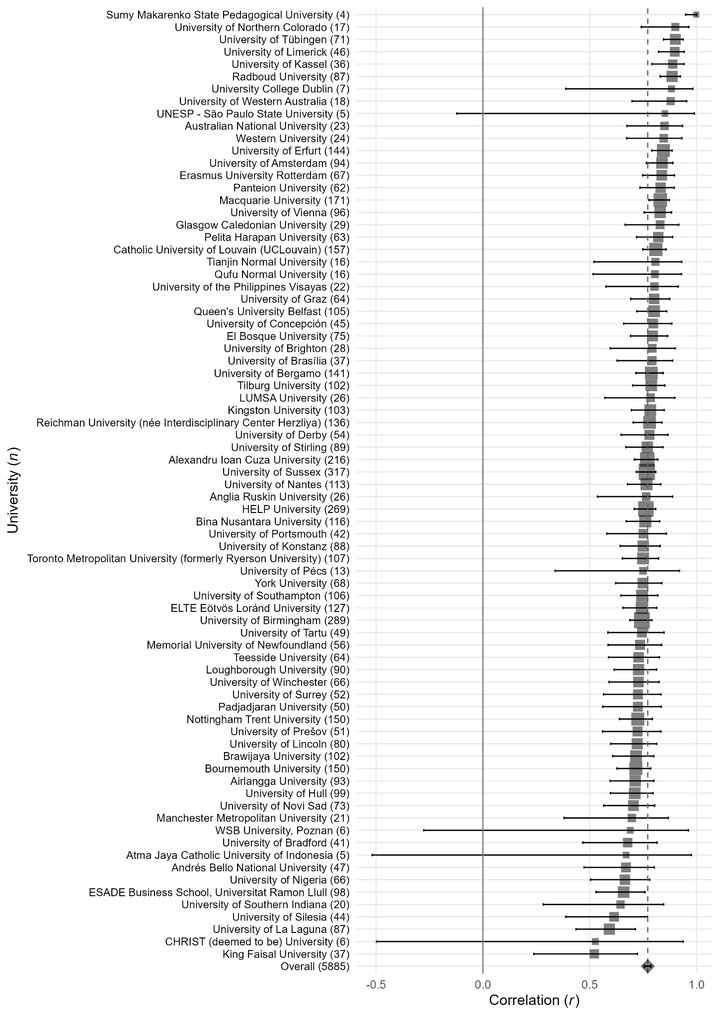
Statistics anxiety is widely recognised as a barrier to student learning, and the Statistics Anxiety Rating Scale (STARS) is its most widely used self-report measure. However, it remains unclear whether the STARS captures a construct distinct from mathematics anxiety or reflects a jangle fallacy. Using a large international sample of undergraduate students (N = 6,885) from 83universities across 33 countries, we examined the empirical distinctiveness of the STARS relative to the Revised Mathematics Anxiety Rating Scale (R-MARS). Across four criteria, the evidence indicated substantial overlap. First, correlations between the STARS and R-MARS were consistently strong. Second, exploratory and confirmatory factor analyses showed that items clustered primarily by type of educational experience (e.g., tests, help-seeking, interpretation)rather than by domain, with limited and unstable domain-specific factors. Third, both scales demonstrated statistically equivalent associations with 11 theoretically related anxiety and education variables. Fourth, the R-MARS explained negligible incremental variance beyond the STARS across these outcomes. Together, the findings suggest that the STARS and R-MARS largely measure the same underlying construct. Their continued separate use risks redundancy,conceptual fragmentation, and statistical artefacts, underscoring the need for clearer construct definition and more precise measurement tools.

Juan David Leongómez
Associate Professor
My research interests include mate choice and human vocal communication, with an aspiration towards understanding musicality. I am also interested in bioacoustics and psychoacoustics, as well as statistics and programming.

María Fernanda Reyes
Assistant Professor
Profesora Asistente (Departamento de Psicología, Universidad de los Andes, Colombia).