Synchronised group singing enhances social bonding more than group conversation or recitation does: A Registered Report across 30 languages.
Abstract
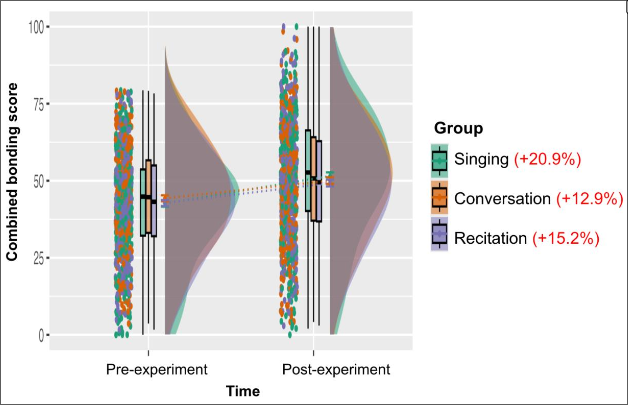
The evolution of music, speech, and prosociality has been debated since before Darwin. The social bonding hypothesis proposes that these phenomena may be interlinked: musicality may have facilitated the evolution of social bonding beyond the possibilities of spoken language. Although dozens of experimental studies have argued that synchronised rhythms can promote bonding, methodological issues including publication bias, sample bias, experimenter effects, and appropriateness of experimental controls make it unclear whether synchronous singing reliably and generally enhances bonding relative to speaking. Following a peer-reviewed Stage 1 Registered Report protocol, we collected data from randomized controlled in-person experiments with 1,017 participants singing and speaking in groups of 5-10 in 30 languages spanning 10 language families and 43 global sites in 32 countries (N = 901 participants after planned quality control exclusions). Our results strongly supported all three of our pre-registered confirmatory hypotheses (all Bayes Factors > 30): (i) synchronised group singing enhances self-reported social bonding (20.9% mean increase), a significantly greater increase than (ii) group conversation (12.9% increase) or (iii) synchronous recitation (15.2% increase). Exploratory analyses suggested that singing’s bonding effects are stronger in non-Western than in Western contexts, perceived synchronisation and enjoyment are key predictors of social bonding, and results are not artefacts of expectancy or group size. Group singing may serve as a better bonding activity than speaking activities in settings such as school or workplace orientation events. More broadly, our study provides strong cross-cultural empirical evidence that music is not merely “auditory cheesecake” that is “useless” compared with language (Pinker, 1997). All forms of vocal communication increase social bonding, but group singing bonds us together over 1.5 times more on average than spoken conversation does.

Jerónimo Quintero-Martínez
Research Assistant since 2025 / BSc Psychology | Research supervision 2024-2025
Research assistant at EvoCo: Human Behaviour and Evolution Lab since 2025, and BSc research project student 2024-2028.

Juan F. Ariza
Research Assistant 2023-2024 / Teaching supervision 2023-2024 / BA Music Education | Research supervision 2018-2019 (Distinction)
Research assistant at EvoCo: Human Behaviour and Evolution Lab 2023-2024, and BA research project student between 2018 and 2019 (Distinction).

Juan David Leongómez
Full Professor
My research interests include mate choice and human vocal communication, with an aspiration towards understanding musicality. I am also interested in bioacoustics and psychoacoustics, as well as statistics and programming.