Reproductive history and cognitive aging: Interactive effects of children and grandchildren in a life history framework
Abstract
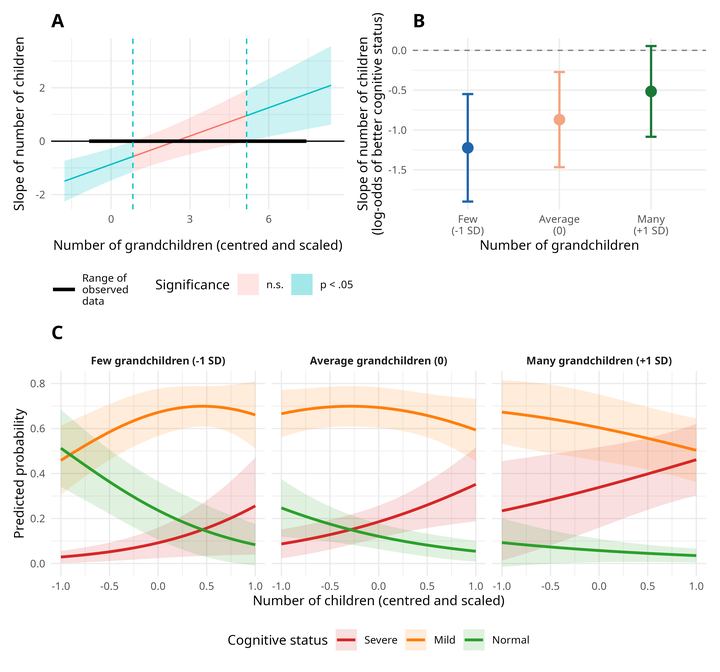
Cognitive decline, particularly Alzheimer’s disease, represents a significant global health concern. While traditional risk factors are well documented, an evolutionary perspective grounded in life history theory offers critical insights into the intergenerational dynamics influencing cognitive aging. This study empirically analyzed the relationship between reproductive history and late-life cognitive performance in women, as measured by the Montreal Cognitive Assessment Colombian version (MOCA-Col). Specifically, we examined the moderating role of the number of grandchildren on the association between parity and cognitive performance. Using an observational, cross-sectional design with a sample of 145 women (mean age = 69.9 years), a cumulative ordinal logistic regression model was fitted to MOCA-Col scores, incorporating age and the interaction between the standardized number of children and grandchildren. A higher number of children was significantly associated with lower odds of being in a better cognitive category (β = −0.869, SE = 0.305, p = 0.0104, OR = 0.42). Crucially, a significant positive interaction between number of children and number of grandchildren was observed (β = 0.354, SE = 0.093, p < 0.001, OR = 1.42), indicating that the negative association between parity and cognition progressively attenuated as the number of grandchildren increased. This evidence supports human life history models and the grandmother hypothesis, suggesting that intergenerational investment may mitigate the cumulative biological costs of reproduction. The findings reflect an evolutionary trade-off between early reproductive effort and later somatic maintenance.
Oscar R. Sánchez
Professor
Professor and Researcher/Director at EvoCo: Human Behaviour and Evolution Lab, Faculty of Psychology, at Universidad El Bosque in Bogota, Colombia.
Juan David Leongómez
Full Professor
My research interests include mate choice and human vocal communication, with an aspiration towards understanding musicality. I am also interested in bioacoustics and psychoacoustics, as well as statistics and programming.